
Dissecting The Monster: Fashion in Frankenstein
It’s a question few designers have to content with – how would I dress the dead? In part one of our Dissecting the Monster, essay duo we’re digging up the work of the costume designers who have, and reflecting on the ways that fashion designers have pulled on the heavy connotations of clothing and the iconic monsters of the movies, to create their own iterations of Mary Shelley’s famous beast.
The First Film Monster
Firstly, before the purists come for me – the original text doesn’t describe the monsters clothing, in fact it’s barely described at all. All we know is it’s tall, muscular, has pale, yellow-ish skin, dark lips, dark hair and watery eyes. Oh, and its monstrous enough that people scream and faint when they see it. So, for the costume designers who have crafted our image of the iconic creature pretty much everything was up for interpretation. There’s something interesting in creating a creature from scratch, each costumer had the freedom to build their own nightmare outfit in whatever way they wished, drawing on the fears, moral beliefs and SFX of their day instead of on an original point of description.
1910’s first showcase of the monster on screen by Searle Dawley takes place in silent black and white, casting characters in the typical melodramatic tropes of the theatre, and presenting the monster simply as the evil that needs to be overcome. This depiction is pretty hard to describe, and weirdly similar to more recent depictions of the character– luckily it’s out of copyright so here you go…
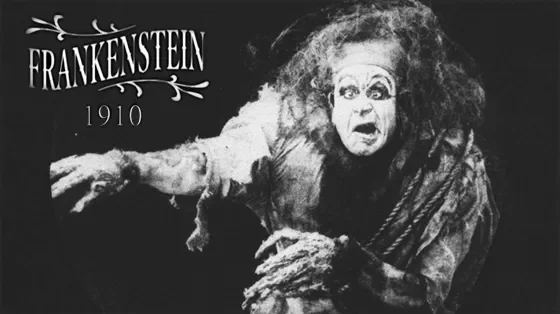
To me, this monster is a purposeful distortion of nature with fingers like branches, a silhouette shaped by hair, muddy layers and natural fibres that looks almost like a hillside. It is the least human of any of the monsters – showing more closeness to animals and nature than to man, it’s draped clothing is part of it – created by the experiments that brought it to life, As with all horror – the costuming also gives us a huge window to the moral mindset of the time, with this monster representing dirt, poverty and also disability in a frankly offensive concoction intended to evoke fear in it’s audiences by reminding them of the real-life circumstances they feared, and the people below them in society, that they tried to ignore.
So often in horror, especially horror including monsters the fear of the ‘other’ comes into play, whether that’s in reference to POC, people in poverty, or whatever other demonised group the society of the time is afraid to confront. In this case the ratty costume reveals a lot about the moral panic of the day in the early 20th century. I this case, as I’ve mentioned inter-class fears made dirtiness, otherness and deviation from social norms something frightening to the middle and upper classes.
“The working class began to call into question the privileged position of the bourgeoisie. In different ways the ruling class defended its superior position in society… These conflicts partly took place on the cultural field of symbolic expressions. The distinction between good and bad culture served primarily to uphold.” (Moral Panics Revisited, Thomas Johansson, 2000)
In this era when a ‘proper’ morally and intellectually ‘superior’ man would never be seen without his hat and smart, fitted suiting, and monster like this was the epitomize of everything that reminded him of his positions fragility.
Frankenstein’s Most Famous Creation
Jump ahead to the 1930s we meet a monster that you probably recognise. The big green head, bolts in the neck and boxy black suit – 1935’s monster is arguably the most iconic of them all. Directed my James Whale, and starring Boris Karloff this version of Frankensteins Monster lives rent free in our heads, whether we’ve seen the movie or not.
A lot of what shaped this character’s costume is actually very literal. The green face – a colour choice made for black and white TV, much like actresses who wore blue lipstick because it looked better than red in black and white the pasty green face was more a choice to make the monster pale and spooky when filmed in black and white, than to actively make it green. The head became big and square because they wanted to make it look like it had been chopped open like a tin to replace the brain, the bolts in the neck for electrocution. All very considered so far to literally tell the story of how this creature came to life. But then more traits were added to make the creature fearsome.
The SFX putty added to the brow, making it particularly low and heavy, creating a ‘neanderthal’ slope that hinted at the monsters low intelligence. In the 1930s the pseudoscience of Phrenology was a huge trend, with ‘scientists’ using the shapes of peoples skulls to determin traits about their character – which as you can imagine resulted in plenty of discrimination and false claims. It’s not a surprise that reshaping of the monsters head was a key costume consideration in this era.
The choice to add platforms and make the monster intimidatingly tall does align with Shelley’s original description, but was actually the first time this particular choice had been actioned in either film or theatre.
The all black ensemble was also a first. Rachedl Lydia Barker (Horror youtuber and critic) spoke in her Frankenstein’s Monster video on the black t-shirt worn in this film, a surprisingly modern feeling base layer for the 30s, but an item that was worn daily by men at the time, as a hidden layer of underwear revealed in the monsters costume. This is the second hint at the taboos of the day revealing something personal, and private, in the public sphere making Whale’s creature now a creature who both threatened intellect and etiquette.
Black of course is another meaningful choice, arguably the clothing colour most associated with darkness, evil and death. Fashion historian Anne Hollander considers the choice to dress the undead in all black for this film as a ‘courting of death’ more so than mourning, as with our 1910 Monster and the more modern monsters that this essay will go on to discuss, the creature lurks in the shadows of dark, non-descript clothing to at once both stand out and blend in. Alluding to common horror threads between black and evil, death and isolation.
This monsters clothing is ill fitting – to emphasise his unnatural size, and inexplicably dirty to reintroduce that element of ‘othering’ that makes the monster feel even more fear inducing to contemporary audiences. As context for the 1930s, following the wall street crash and dive into the Great Depression, men were wearing much less ornate suiting – swapping out the previous decades more ornate and fitted jackets for longer sports jackets and detachable collars. Yes they still looked put together as hell in the context of what we are wearing today, but it was a bit step towards more casual clothing. How does that fit in with this particular monster? Well his black, too-small, overly structured jacket is remarkably out of fashion. Forgive how remarkably un-PC this is about to sound but in the eyes of lots of the higher-class members of society even now those who are knowingly out of fashion, are giving a visual indicator of having something ‘wrong’ with them. Maybe they’re impoverished, spirited and rebellious, unwell, or just nonconformist – but either way within film and unfortunately reality too, a person visibly dressed of the wrong era or in an unusual, socially unacceptable combination of items, if often immediately flagged as an outsider and someone to fear.
Modern Monsters
In two more recent iterations of the film Christopher Lee & Robert DeNiro play very similar monsters, and this is where costume designers seem to lose the imagination to reimagine a monster of their own creation. The 1957 The Curse of Frankenstein and the 1995 Mary Shelley’s Frankenstein both present monsters who are pale, covered in visible scarring, and wearing long black coats. It is actually part of the original text that the monster picks up a coat on it’s journey to keep itself warm, so in these cases the designer stay true to the text. But what a lack of imagination that the creatures wear ominous black coats, and that their otherness is blatantly and crudely communicated through a series of scars and disfigurements.
Of course the most recent monster to discuss is Jacob Elordi, in Del Torro’s 2025 Frankenstein. A tall muscular monster who probably best fits Shelley’s own description, following on in great similarity to the two creatures notes above, except that it’s scarring does not produce a disability or particularly gruesome effect. (for reference both DeNiro and Lee play creatures with only one working eye each, and have brutal, catapillar-esque stitched scars and oozing flesh respectively. Whilst Elordi is a monster – sure, but not one immediately revolting.
My main criticism of a film which I actually found very beautiful is that the storyline has been reduced to a very simple: Frankenstein evil, Monster good. (And woman – object of romance to become collateral damage between the men during their power struggle.) But with that being the chosen tale, the film tells it well. The costuming is also Stunning, and to be honest there’s a lot more to say about Frankenstein and Elizabeth costumes than the monsters. (stay tuned for that essay…)
The monster alone goes from baby-reminiscent in his diaper made of hospital cloths, to donning the coat of a dead soldier which literally has a spine imprinted down it’s back as a 3D detail, to emphasise it’s connection with death. This version of the monster seems to draw on tropes established by the 1950s monster, by stealing and adding items as he travels different landscapes, and by becoming more layered, dishevelled and sculpted by its surroundings as the narrative progresses. Till it almost becomes reminiscent of Dawley’s 1910s creature.
Why have we stuck on the same image of a monster for the last 70 years? Well we’re kind of stuck in a circle of moral panics that we haven’t really been able to break out of.
“moral panics are still caused by threats against adult norms and ideals. These threats may either be related to working class kids’ use of ’bad culture’ and their aggressive behaviour, or to the increasing masculinization and feminization of certain parts of youth culture… they may be primarily related to clashes between different ethnic groups and towards antidemocratic tendencies within
youth culture” (Moral Panics Revisited, Thomas Johansson, 2000)
We circle around the various ‘others’ who sit as a threat to the middle-upper class status-quo. Whether they threaten our kids heteronormativity, whiteness, sexual purity or obedience. Hence, the monster who threatened the ‘balance’ of nature has become a patchwork figure wearing a ubiquitous black coat, we can’t tell where he came from, or what he wants, and that lack of immediate class recognition strikes fear into us.
Dirt and Decay
One common thread between all our creatures today – they all end their films really fucking dirty.
Perhaps the purity of the initial ‘birth’, where monsters appear naked, enshrouded or in their white cloths, can only ever become tainted whilst living outside the protective structures of society. And as each rejection, cruelty or loss leaves the creature more and more angry it’s appearance becomes bigger, darker and dirtier – symbolising the unruly, danger its lack of conformity represents. On a deeper level, the accumulation of dirt and ultimately decay through second hand, weathered clothes that hold onto the damages of their lifetime brings the abject into the costuming.
Jonathan Fraiers has noted on the importance of stains in cinematic costume – quoted as entering the scene and ‘literally imposing themselves on the garment, and by extension the wearer” - what are stains, rips and marks if not evidence of life passing the wearer by? Well worn clothes feel shocking next to the smart, starched, permanent feeling fashions of particularly the earlier Frankenstein movies - where restriction and smart white collars represent security and separation from nature, dirty borrowed clothing can only remind us of humanity, and ultimately mortality. How fitting for an undead creature to storm in a remind us that we will one day die.
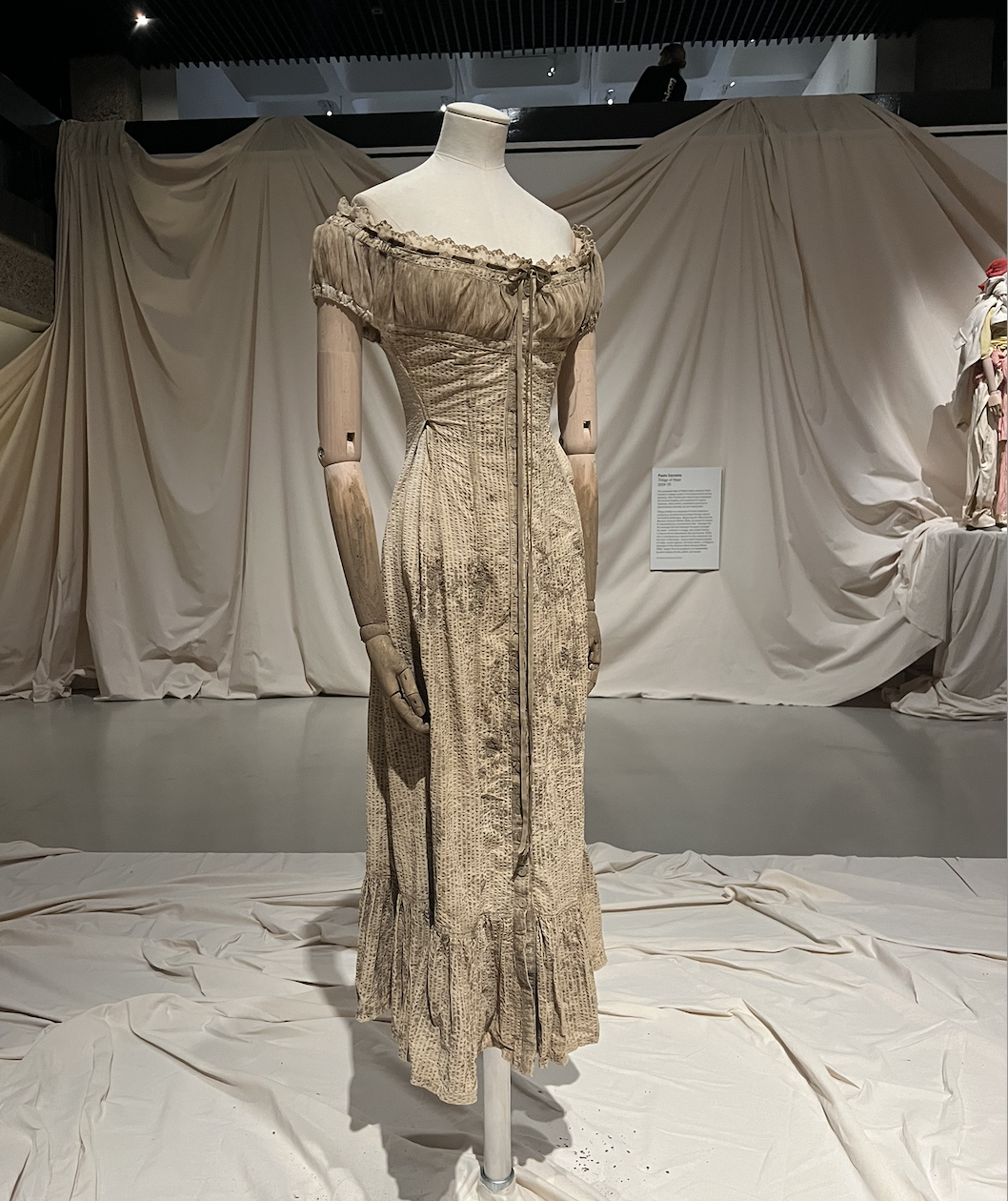
(we wrote a whole article on the abject body and fashion - read it here)
Frankenstein Fashion
Designers subtly reference Frankenstein’s monster time and time again, in effect becoming a Frankenstein character themselves as they rework, patch and resurrect characters from the past. Whether McQueen stitching segments of a body cast corset together in thick red thread, or Prada featuring graphic drawings of Frankenstein’s monster and bride on their clothing the terrifying, abject, reject was always going to become a muse in an industry that glamorises the struggling, rejected, underdog.
Whilst in the original tale, Frankenstein himself has a pretty questionable moral compass, for fashion designers today being a bit of a Frankenstein is probably the best way to create. With enough textile waste on earth to clothe our kids, grandkids, grand-grand kids and more, utilising them for spare parts makes so much sense. And crafting new characters that challenge our levels of repulsion, acceptance and humanity through reworking the past is pretty perfect.
Next time you see a black suit with a t-shirt, platforms with high, square shoulders or layers repaired with thick visible stitches – give a thought to the original outcast who inspired them.